|
Ragtime Music in
Canada
Chapter 1: The Introduction of Ragtime into Canada from the United States
By Ted Tjaden [return to Table of Contents] [go to Chapter 2] The
history of music in Canada reflects the
tri-cultural influences that initially shaped our
country. First Nations people, the French, and the
British have all made unique contributions to the
musical heritage of our country. The influence of
each culture on this heritage, however, has varied
over time with aboriginal music perhaps being the
least understood by most Canadians (reflecting, in
part, systemic discrimination against First
Nations people in this country). With the French
being the dominant early culture, French music
played an important early role in Canadian music
with British immigrants also bringing with them to
Canada their musical heritage. Before discussing
the adoption of ragtime music from the States in
the early 1900's, it may therefore help to have a
basic understanding of the pre-ragtime state of
music in Canada before that time. This is followed
by a discussion of the spread of American musical
influences into Canada. Information on this page
is therefore set out below on the following
topics: Before European settlers came to what is now Canada, our region was occupied by a large number of aboriginal people, including the West Coast Salish and Haida, the centrally located Iroquois, Blackfoot and Huron, the Inuit people to the North, and the Mi’kmaq in the East. Each of the aboriginal communities had (and have) their own unique traditions, including musical traditions. However, one major difference between Western music and aboriginal music is that much of aboriginal music is associated with rituals and religion:
Besides chanting and singing, many First Nations people would use a variety of musical instruments crafted from available material. McGee (1985:145), for example, points out that the Algonquians used instruments such as rattles, drums and wooden flutes. Aboriginal music is not widely performed, compared to other styles of music. For an example of one style of aboriginal music, see the Tea Dance of the Dogrib or Tli Cho First Nation (of the Northwest Territories). McGee (1985:142) points out that some aboriginal musical traditions are being lost but attempts are being made to preserve this music:
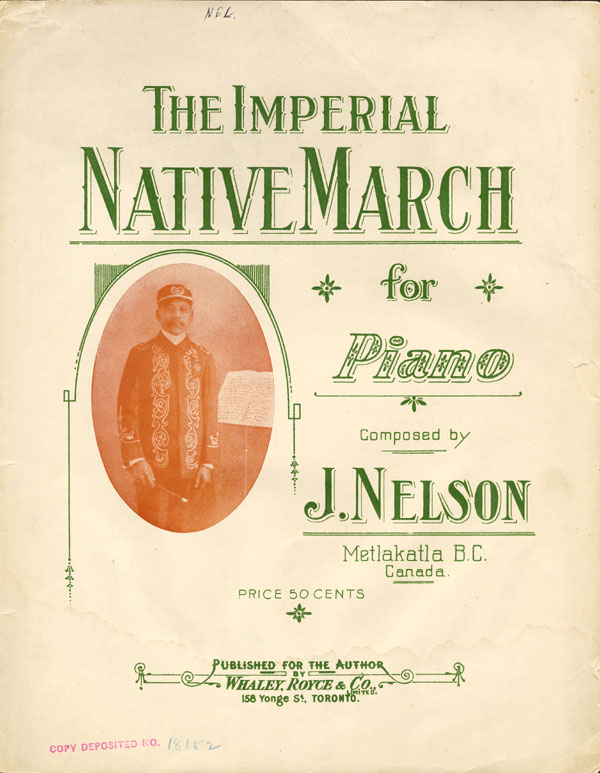
McGee's comment that there is little observable influence of aboriginal music on Western music among aboriginals is significant, due likely in part to completely different origins of the music, different musical styles and harmonies, and so on. Ragtime and ragtime-era music, like most Western music, has not done a lot to integrate aboriginal music. One notable exception to this was Job Nelson, an native Indian who wrote The Imperial Native March (below) and was the conductor of Nelson's Cornet Band and the Metlakatla Brass Band on the north coast of British Columbia around the turn of the century (Maloney).
Rather than there being any serious incorporation of aboriginal music into ragtime (or other forms of Western music) there was instead a few ragtime composers would incorporate fairly stereotypical Indian-sounding melodies or drum beats into their pieces.
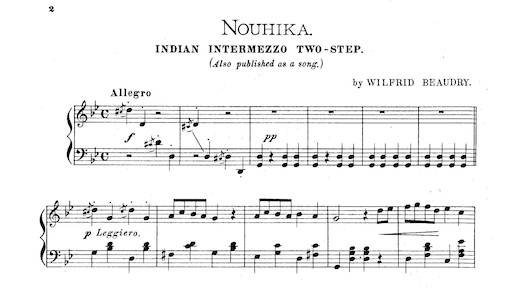
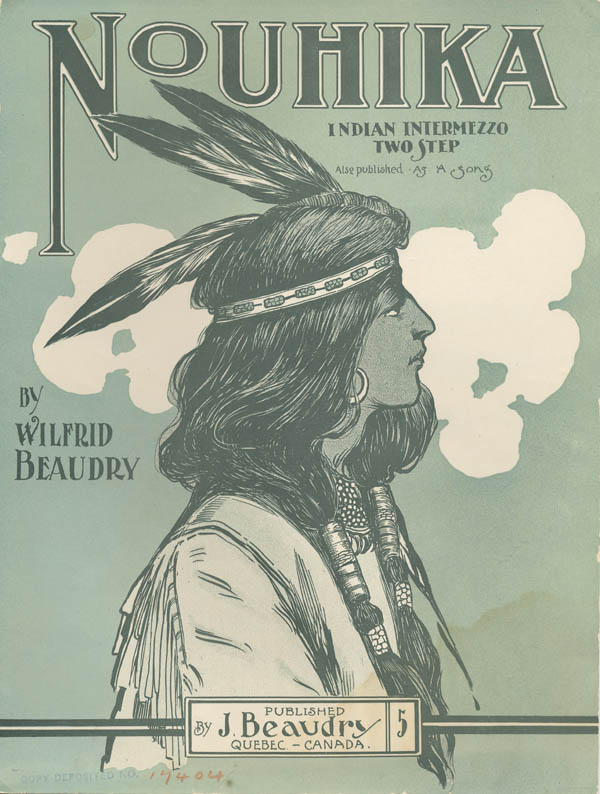
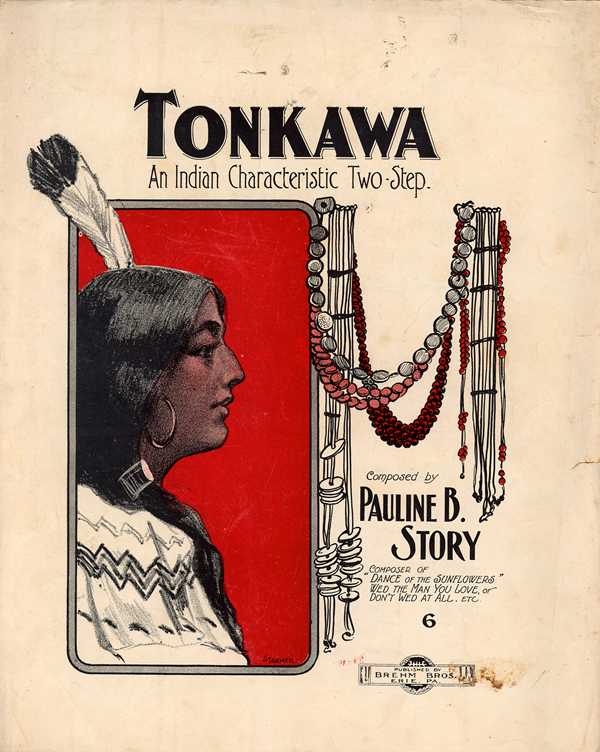
Two of the many types of this ragtime-era "Indian" music are set out below, one Canadian (Nouhika: Indian Intermezzo Two-Step) and one American (Tonkawa, Indian Characteristic Two-Step). Much of this imitative type of music is not that memorable or noteworthy; however, in its favour in the examples below, the artwork is not overly stereotypical or offensive as some examples of African-American caricatures that sometimes appear in ragtime sheet music covers (although the covers below do represent a typically European romanticized view of aboriginal people).
b) French Music The music brought to New France by French explorers and immigrants has had a lasting effect on the Canadian music legacy. Kallmann (1960:25) estimates that "of the seven to ten thousand songs that have been collected in the province of Québec in recent years, fully nine-tenths are derived from songs brought to Canada before 1673." He goes on to describe the influence of French music:
McGee (1985:2) describes the contribution of French folk music in similar terms:
In fact, music was a daily part of life for most French settlers:
Has French Canadian musical culture influenced Canadian ragtime music? Likely not. It is difficult to pinpoint actual influences on ragtime music per se; however, French music has clearly had a strong influence on folk music more generally (every Canadian knows the French folk song called "Allouette!", for example). In addition, the province of Québec has played an important role in Canadian ragtime as being the residence of ragtime composer Jéan-Baptiste LaFrenière (see my separate essay about him and his music for more information) and Wilfrid Beaudry (click here for sheet music of songs he has composed; however, I have been unable to find out much about him). The city of Montreal was also the seat of ragtime and jazz music in Canada with ragtime residents including Willie Eckstein, Vera Guilaroff and Harry Thomas (see Chapter 2 for more information on them) due in part to lax liquor laws during Prohibition and the presence of a large black population of musicians (Gilmore 1988:29-30). For more on the music of Québec, see any of the following websites:
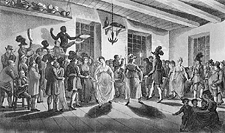
Various types of folk music from the British Isles were introduced into Canada by early settlers from that region:
Folk music from the British Isles included jigs and reels and other dance music that many Canadians are familiar with:
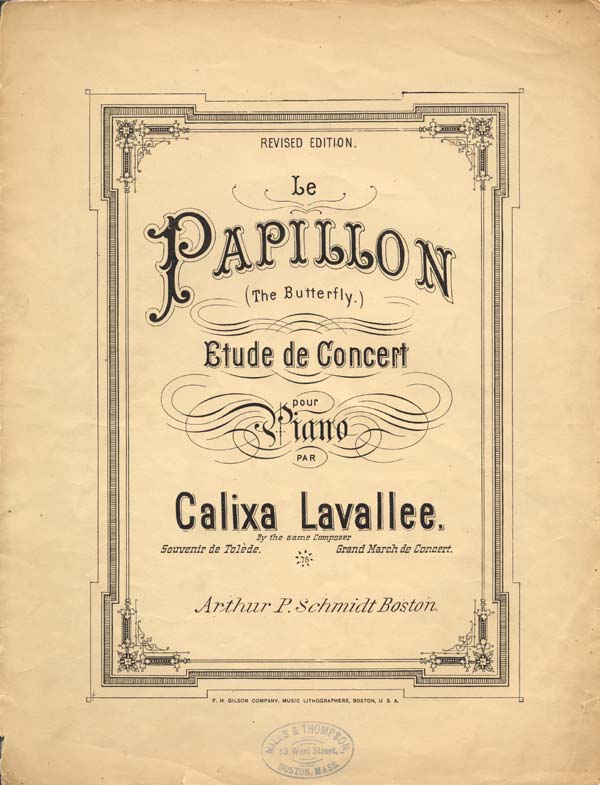
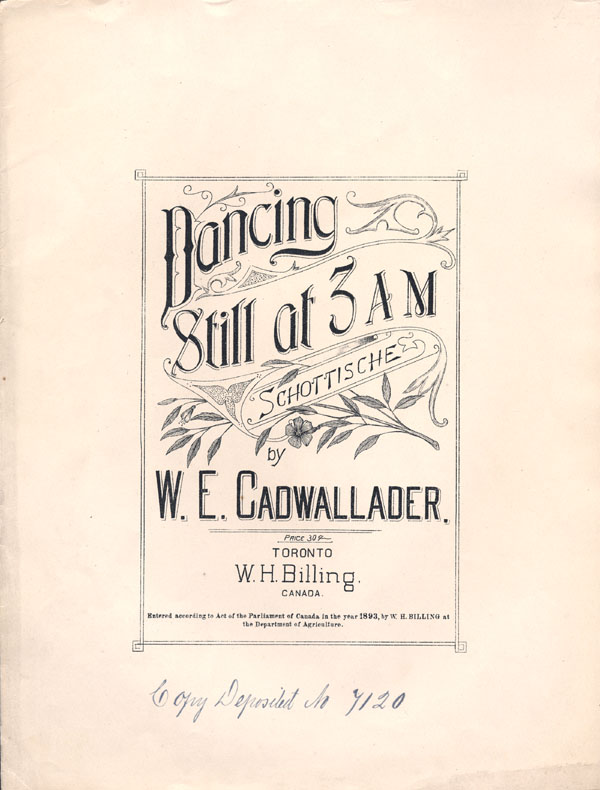
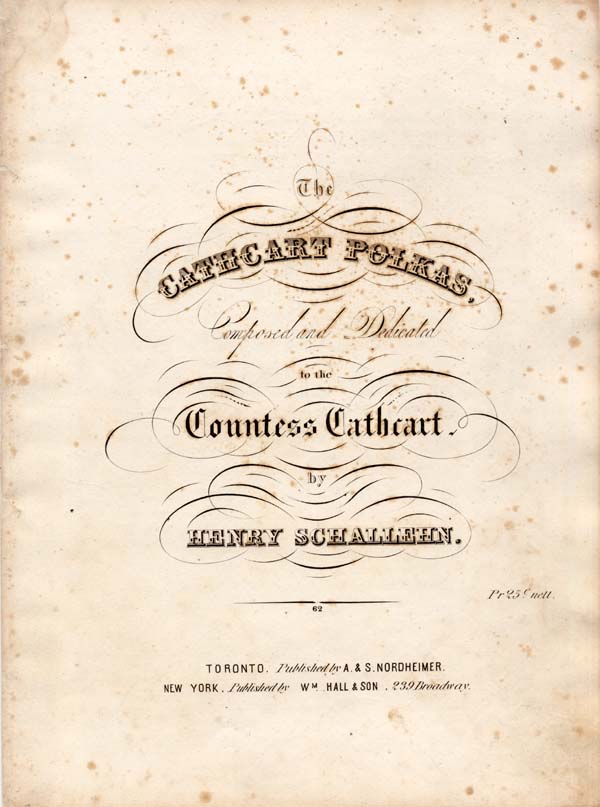
The influence of British folk music on Canadian ragtime is not direct but instead has more generally influenced the broad types of dance music composed by early settlers to Canada. There were of course Canadian "classical" composers, such as Claude Champagne (Québec, 1891-1965) and Sir Ernest MacMillan (Ontario, 1893-1973), who drew on influences from Europe. But closer connections to ragtime are likely found with the syncopated dance music from the pre-ragtime era, including polkas, marches and schottisches. It is impossible, for example, to think of the Canadian fiddle music of Don Messer without this direct influence of reels and jigs from the British Isles. To listen to a few samples of this sort of music, try any of the following links:
Set out below are three piano compositions by Canadian composers, pre-ragtime:
e) African American Immigration to Canada As mentioned above, the early musical influences in Canada were European, primarily as a result of the musical traditions brought by immigrants from France and Great Britain. However, with increased settlement in the American colonies, there was increased north-south movement between the United States and Canada, and with the American Revolution came an increased number of American colonists and African-American slaves:
Mensah (2002:46) puts the total number of African-Americans during this period at several thousand, with a large majority of these escaped slaves settling in Nova Scotia:
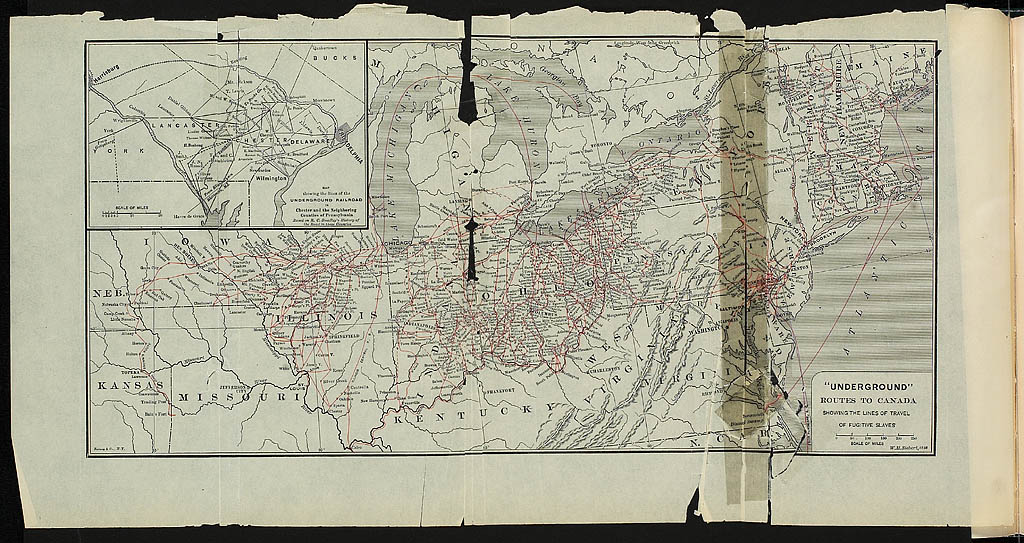
Canada became famous as the terminus of the "Underground Railroad," a metaphor for the "escape routes" that American slaves took to escape their servitude and to live in relative freedom in Canada:
Gilmore (1988:21-22) describes the Underground Railroad in these terms:
Many of the African Americans coming to Canada at this time ended up in southern Ontario, including, it is believed, the parents of R Nathaniel Dett, a Canadian ragtime composer discussed in more detail in Chapter 2:
Simpson (1993:1) puts the figures of Blacks in 1840 at 10,000 in Ontario, being the largest proportion of a total of around 60,000 slaves in Canada at that time. Gilmore (1988:20) describes a third wave of African-American immigration into Canada when "between 1916 and 1918, one of every twenty blacks in the South – a total of more than 400,000 people- migrated northward in search of work and a better life" where "[a] few of them spilled across the border into Canada ...." He notes the (positive) impact this had on the introduction of musical influence:
One important area that spawned ragtime in Canada was the city of Montreal where it is estimated that there were between 500 to 1,000 blacks living in the late 1800's (Gilmore 1988:22). The development of the Grand Trunk Railway and the Canadian Pacific Railway created employment for some blacks as porters and "sporting clubs" began to spring up in St Antoine district of Montreal in the late 1800's where music became an important part of the community:
As mentioned above, Montreal was where Canadian ragtime composer Jéan-Baptiste LaFrenière spent his youth and where he later worked as the pianist for the Eldorado Café-Concert Orchestra from 1899 to 1901. f) Canadian Reaction to Ragtime Music It would seem that ragtime music was received with mixed reactions in Canada, as it was in the United States (see, for example, Neil Leonard, "The Reactions to Ragtime" in Hasse (1985:102) for American reactions to ragtime). In Canada, there was a strong conservative, Puritan attitude held by many in authority that led, among other things, to until only quite recently the repeal of laws that closed stores for Sunday shopping in Canada in most provinces. This Puritan attitude is reflected in the following article from the August 15, 1902, edition of The Globe in which a teacher comments that "evil" ragtime music should play no part of the kindergarten curriculum:
Likewise, a few months later in the December 23, 1902, edition of The Globe, in the "Music and the Drama" section, a review of an operetta by Sir Arthur Sullivan talks of the "tyranny" of ragtime and two-steps:
However, the same newspaper on October 17, 1903, page 19, printed the following praise of ragtime music by none other than John Philip Sousa:
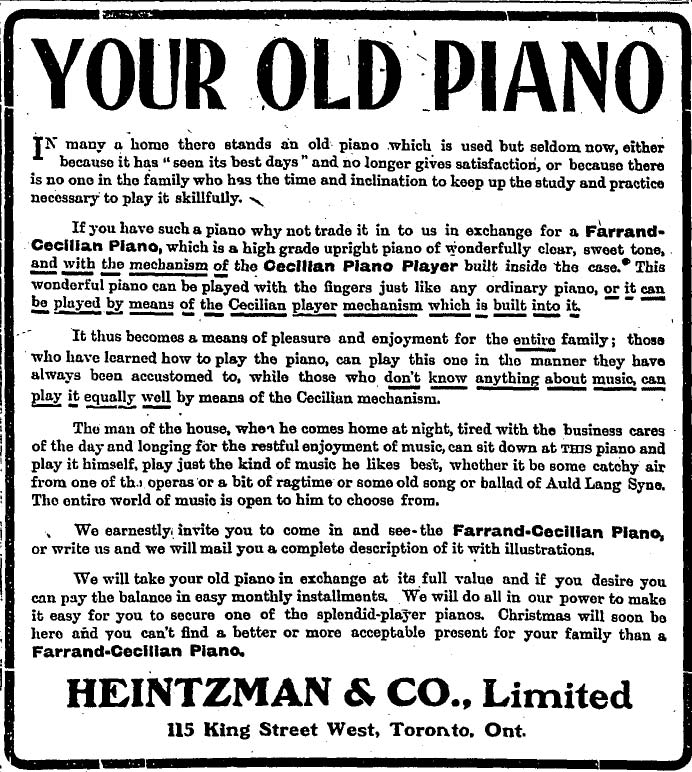
In addition, ragtime was popular enough to be used, in part, by Heintzman and Company to promote their pianos in the following advertisement from the December 6, 2005, edition of The Globe:
Like it or not, ragtime music was clearly part of the Canadian musical landscape in the early 1900's. However, it would seem that ragtime was only one of several styles of instrumental music being played at this time in addition to any number of saccharine waltzes or patriotic songs and marches. Kallmann (1960:260) describes the type of music being produced in Canada during this time in these terms:
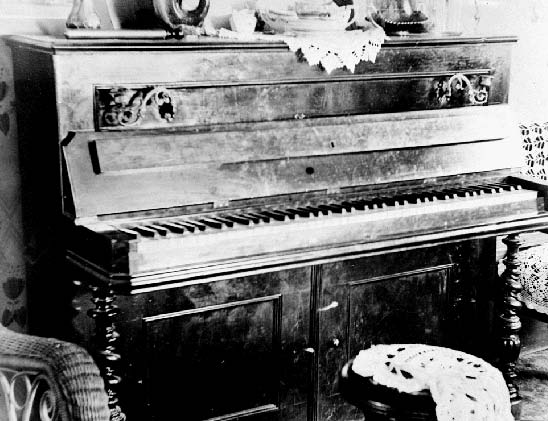
Kallmann (1960:160) also provides a nice description of how important the demand for pianos was to support this type of music and the efforts that were necessary to transport them across the country as settlers moved westward. He describes a piano being delivered to the Red River Academy military station on the site of modern Winnipeg as early as 1833 and further westward:
According to Kallmann (1960:162) several dates for early pianos in Western Canada are: Victoria circa 1851; Prince Albert 1880; Lethbridge 1887; and Vancouver 1860. Kallmann suggests that part of the demand for pianos was due to the desire of pioneer women to have a civilized form of entertainment:
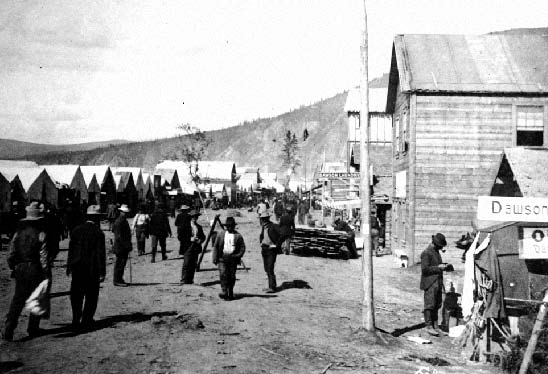
g) Ragtime Music and the Gold Rush The Caribou Gold Rush in British Columbia in the 1860s and the Klondike Gold Rush of 1896 to 1899 in Dawson City, Yukon Territories, in the Canadian North brought tens of thousands of fortune-seekers to these areas. The immediate wealth (or sense of wealth) that was created by these Gold Rushes resulted in a roaring entertainment district with fancy hotels and saloons and gambling joints, perhaps not unlike the "sporting districts" of Joplin's Missouri (albeit with a slightly different clientele). In Downrigh Upright: A History of the Canadian Piano Industry (Kelly 1991:15), author Wayne Kelly describes how the gold rush in the Caribou and the Klondike spurred a demand for pianos as a form of entertainment:
Kelly (1991:15) describes a sister singing group, the Sunny Samson Sisters, who arranged to have their piano carried to the top of the 1,200 foot elevation Chilkoot Pass on their way to Dawson but who were denied entry by the RCMP and had to return to Skagway where Kelly writes was a town "lousy with pianos" at the time.
Berton in Klondike: The Last Great Gold Rush (1896-1899) (Berton 1972:354) describes Dawson from July 1898 to July 1899 (at the peak of the gold rush) as the "San Francisco of the North" with many amenities not available in other North American cities:
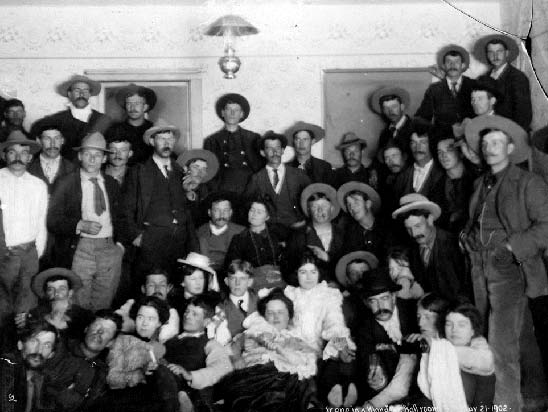
Berton further suggests that many of these saloons and dance halls were sources of great revenue for their owners and the dance girls who worked there when he states that "Dawson's entertainments, although they brought thousands into the dance halls, were only a means to an end, and that end was to extract as much gold as possible from the audience when the entertainment was done" (1972:365). From the photo immediately below of a Klondike "ballroom" we can imagine how relatively "rough and tumble" some of these ballrooms likely were.
The poet Robert Service (1875-1958), a British citizen, but more famous as a bank clerk resident in the Yukon who wrote poems about life in the North, in fact mentions ragtime in one of his most famous poems "The Shooting of Dan McGrew" from The Spell of the Yukon and Other Verses. In the opening stanza, he sets the scene of the poem in the Malamute saloon were a "kid" is playing ragtime on the piano (emphasis added):
In walks a stranger, crazed with "hooch" who eventually sits down at the piano to belt out a tune while the ragtime kid has a drink:
The poem ends in a shootout between this stranger and Dangerous Dan McGrew apparently over the lady that's known as Lou (you'll have to read the poem to see how it ends). Berton (1972:361) describes the Rag Time Kid from the Dominion Saloon, a possible model for Service's jag-time kid. According to Berton, the Rag Time Kid was challenged to a piano contest by entertainer Wilson Mizner who thought, in error, that he could outperform the Rag Time Kid:
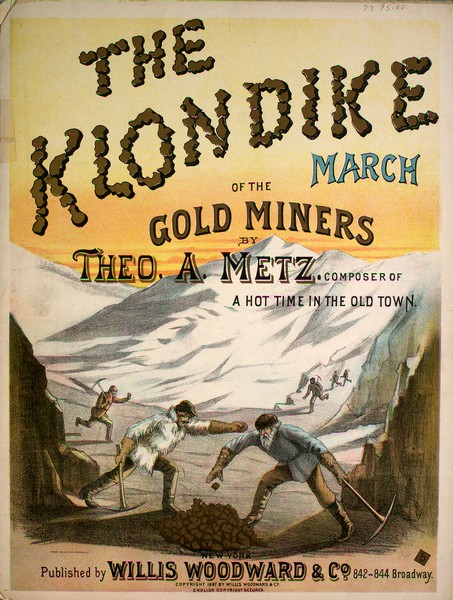
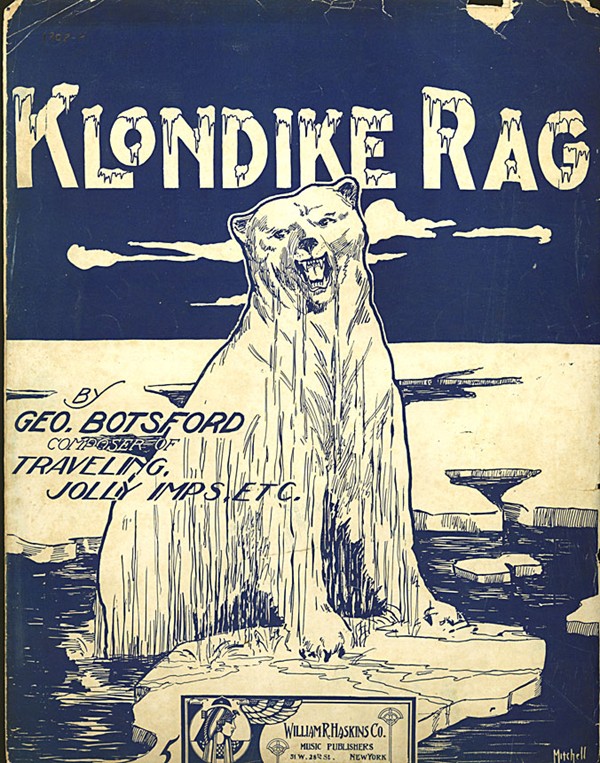
The gold rush was a popular theme for sheet music during the ragtime era. Two examples of American pieces from the era are the The Klondike March of the Gold Miners (1897) and the Klondike Rag (1908) (there are plenty more). In addition, the two Canadian pieces listed below unfortunately appear to only be available in print, and if I am able to obtain copies, I will digitize them and put them online (note: the first piece below is written by the father of Canada's 14th prime minister, John G Diefenbaker):
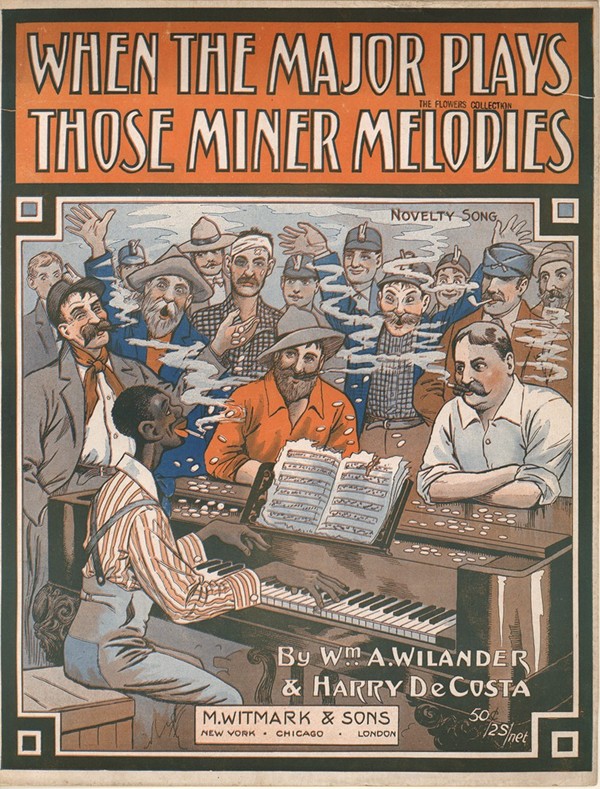
Another ragtime era song dealing with mining is When the Major Plays Those Miner Melodies by Will Wilander and Harry DeCosta:
In the next chapter, I discuss some of the more important early ragtime composers and personalities in Canada, including Ivor (Jack) Ayre, R Nathaniel Dett, Willie Eckstein, Vera Guilaroff, May Irwin, Jéan-Baptiste LaFrenière, Joseph F Lamb, Geoffrey O'Hara, Fred S Stone, Harry Thomas, and Charles E Wellinger. |
||||||||||||||||||||||||||||||||||
|
This site created by Ted Tjaden. Page last updated: January 2026.
|